India will upgrade its Technical Mission in Kabul to a full-fledged Embassy, External Affairs Minister S Jaishankar announced on Friday. He made the statement after meeting Afghan Foreign Minister Amir Khan Muttaqi in New Delhi.
Jaishankar said the move reflects India’s continued support for Afghanistan’s sovereignty, stability, and development. He noted that deeper cooperation will strengthen both nations and enhance regional resilience. He stated, “To enhance that, I am pleased to announce today the upgrading of India’s Technical Mission in Kabul to the status of Embassy of India.” This move reflects India’s intent to deepen engagement and support stability in the region.
India reaffirms commitment to Afghanistan’s development
India had closed its embassy in Kabul in 2021 after the Taliban seized power following the withdrawal of US-led NATO forces. A smaller technical mission reopened in 2022 to manage trade, humanitarian aid, and medical assistance.
Currently, several countries — including China, Russia, Iran, Pakistan, and Turkey — maintain embassies in Kabul. However, Russia remains the only nation to have formally recognised the Taliban administration.
Jaishankar said India’s development partnership with Afghanistan will continue, focusing on both existing and pending projects. He reaffirmed that India’s cooperation is guided by goodwill and respect for Afghan sovereignty.
New projects and medical aid announced
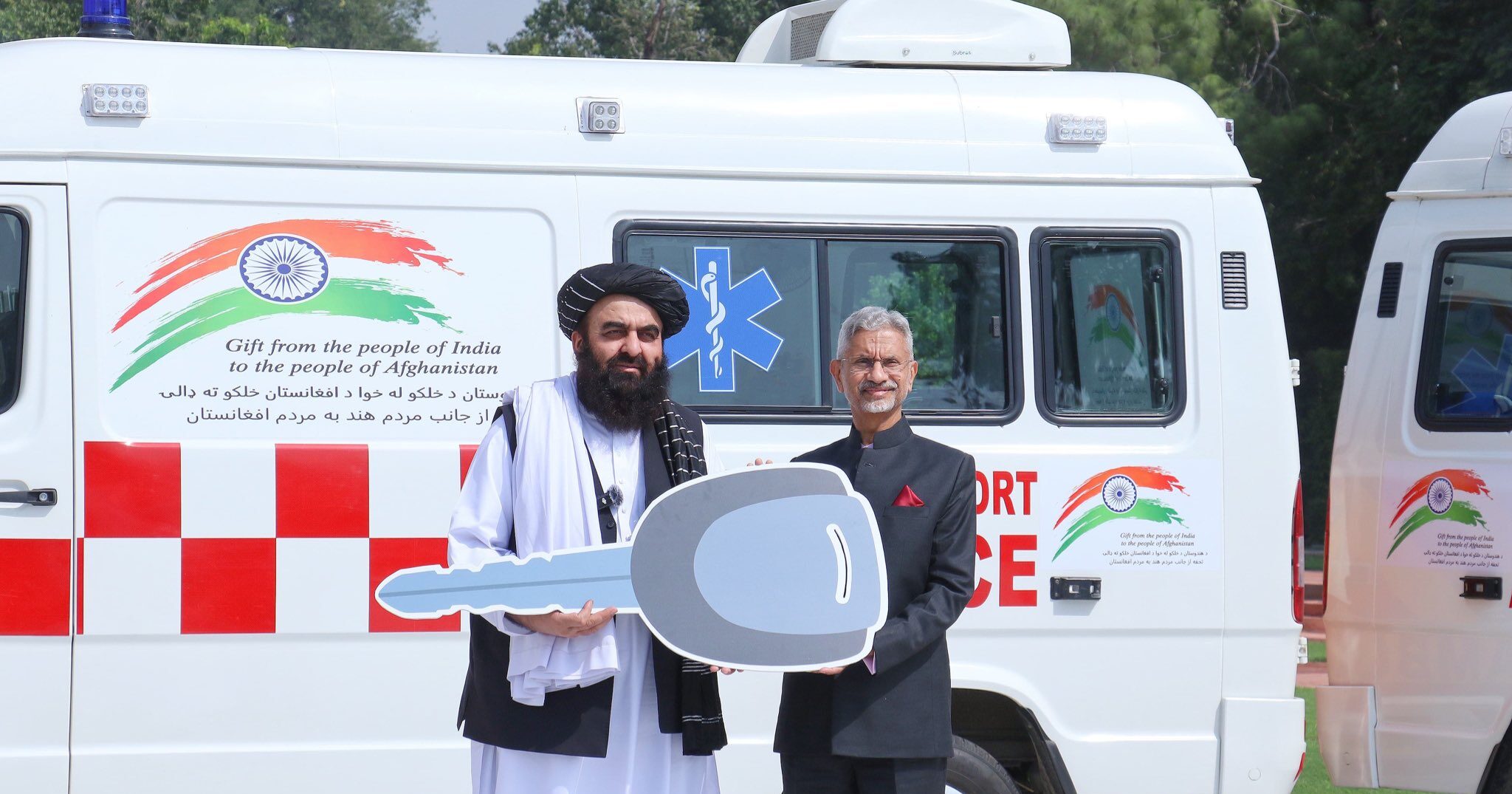
Highlighting India’s consistent humanitarian support, Jaishankar announced six new development projects for Afghanistan. He also presented 20 ambulances, calling it a ‘gesture of goodwill’, and personally handed over five of them.
India will additionally provide MRI and CT scan machines to Afghan hospitals. Further, it will deliver vaccines, cancer medicines, and rehabilitation materials through the UN Office on Drugs and Crime (UNODC).
“As a first responder, Indian relief materials were delivered to earthquake-hit areas within hours last month,” he said.
He added that India would help reconstruct residences in affected regions and send another consignment of food assistance to Kabul.
Support for refugees and local reconstruction
The minister also voiced concern over the forced repatriation of Afghan refugees. He said India supports their dignity and livelihood, offering to build housing and continue material aid for their rehabilitation.
“The plight of forcibly repatriated Afghan refugees is a matter of deep concern. Their dignity and livelihood are important,” Jaishankar said.
Both ministers discussed water management, trade, and education as key cooperation areas. India is ready to collaborate on sustainable water resource management and welcomed Afghanistan’s interest in this field.
Jaishankar also appreciated Afghanistan’s invitation to Indian companies for mining exploration, noting that discussions would continue.
He highlighted new flights between Kabul and New Delhi, expanding connectivity and commerce between the two nations.
India to support Afghan students and sports talent
Education and sports remain strong pillars of India–Afghanistan ties.
Jaishankar said India would expand scholarships for Afghan students and strengthen academic exchange programmes.
“Our educational and capacity-building programmes have long nurtured Afghan youth,” he noted.
He praised Afghanistan’s cricket achievements and said India would continue to support its cricket development. India’s new visa module for Afghan citizens, introduced in April 2025, allows more visas for medical, business, and student categories.
Joint resolve against cross-border terrorism
During the meeting, Jaishankar also emphasised the need to counter cross-border terrorism jointly. He said both nations must cooperate to protect peace and prosperity in the region.
“We must coordinate efforts to combat terrorism in all its forms. Your solidarity with us after the Pahalgam terrorist attack was noteworthy,” he added.
Afghan Foreign Minister Amir Khan Muttaqi is on a six-day visit to India aimed at boosting bilateral engagement. The trip was made possible after the UN Security Council Committee temporarily lifted a travel ban on him.
The UN continues to sanction Muttaqi, enforcing a travel ban and asset freeze, though it occasionally relaxes these restrictions for diplomatic engagements.
His visit marks an important step toward reviving structured dialogue between India and Afghanistan after years of limited engagement.