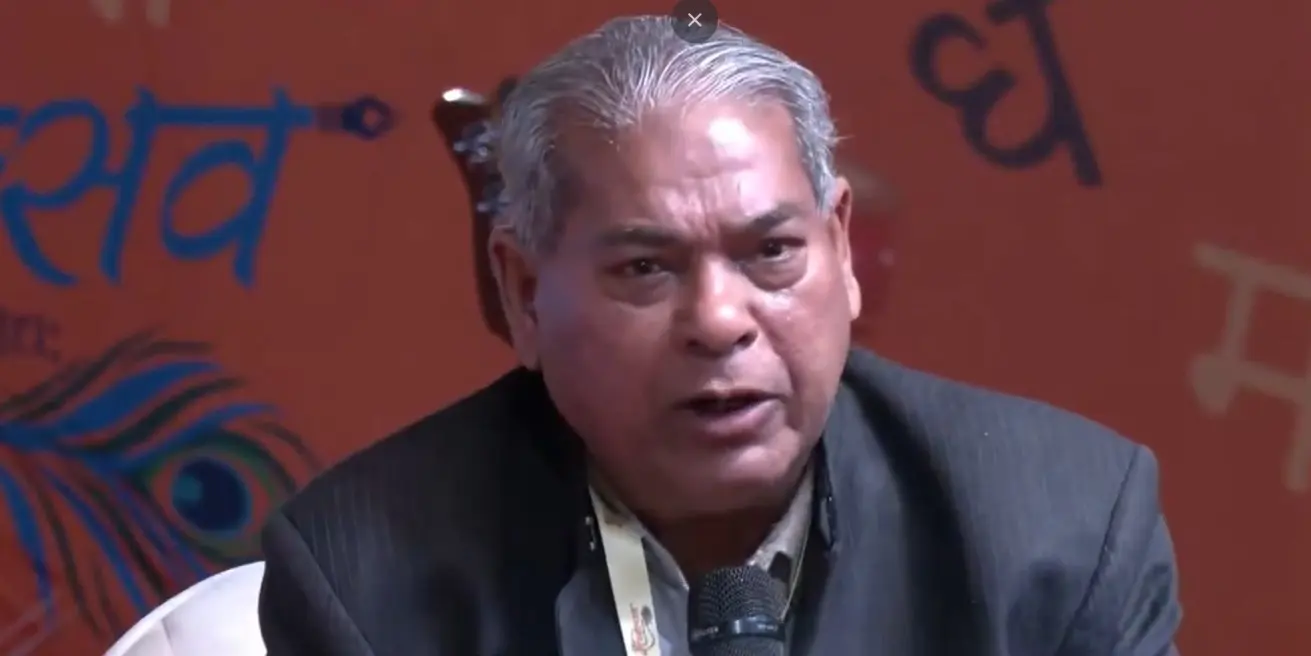
Former Archaeological Survey of India (ASI) scientist Dharam Veer Sharma has made a bold claim about Delhi’s iconic Qutub Minar. He stated that the structure is not a minar, but an ancient astronomical observatory.
Sharma shared his findings while speaking at Shabdotsav-2026, currently underway in Delhi. His remarks have triggered fresh debate among historians and researchers.
Two years of research reveal new facts
Dharam Veer Sharma, who earlier served as Regional Director of the ASI, said he studied the monument for two years. During this research, he discovered several new structural details. Although no written documents mention these findings, Sharma said science offers clear proof.
He explained that every structure is built with a purpose. Therefore, its design reflects its intended use.
Rectangular foundation raises questions
According to Sharma, the Qutub Minar looks circular from the outside. However, its foundation is rectangular, which he finds unusual. He said a true minar or tower should have a circular base. This mismatch, he added, points toward a different original function.
Moreover, Sharma said the structure shows strong links to astronomical science.
June 21 shadow phenomenon supports theory
Sharma highlighted a key astronomical observation. On June 21, the longest day of the year, the sun enters Dakshinayana. On this day, the shadow of the Qutub Minar disappears for nearly 30 minutes.
He said such precision cannot occur by chance. Instead, it strongly suggests deliberate scientific planning.
Foreign invasions altered original structure
Sharma further claimed that foreign rulers damaged the original observatory during invasions. Later, they modified the structure to suit their needs. Over time, people began identifying it as the Qutub Minar.
He stressed that ancient India possessed advanced scientific knowledge. According to him, monuments like this reflect that expertise.
Debate gains momentum
Sharma’s claims have reopened discussions on India’s architectural and scientific past. While experts continue to debate, his findings have added a new dimension to the understanding of the Qutub Minar.
For more latest updates, click here.