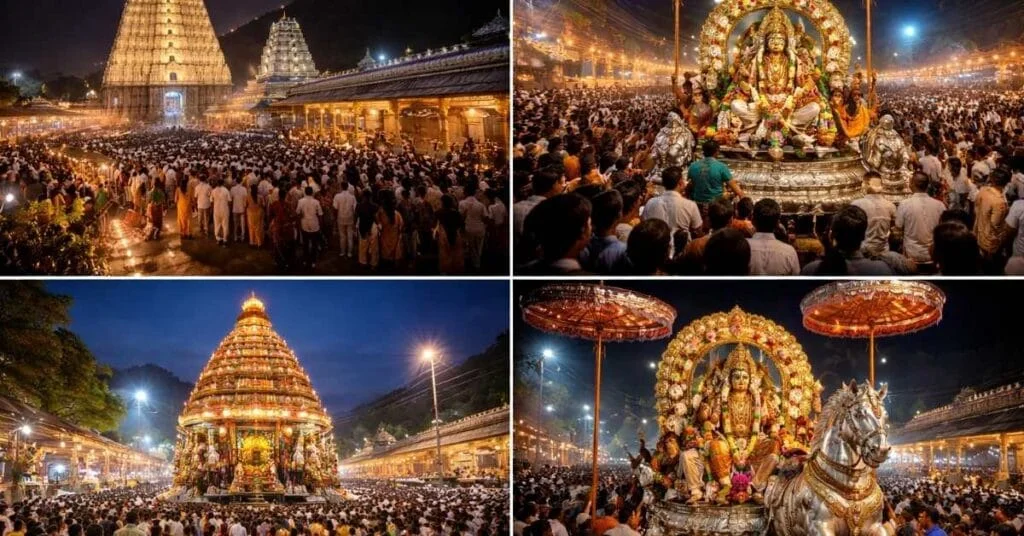
Among the many sacred shrines of Lord Shiva across India, Srikalahasti Temple holds a unique and powerful place. Revered as “Dakshina Kailasa,” this temple represents the Vayu element among the Pancha Bhoota Lingas. Devotees believe that a visit to this holy shrine grants spiritual liberation. Therefore, during Maha Shivaratri, lakhs of pilgrims gather here seeking divine blessings.
Sacred Shrine on the Banks of Swarnamukhi
Located in the Tirupati district of Andhra Pradesh, the temple stands gracefully on the banks of the Swarnamukhi River. Unlike typical Shiva Lingas, the deity here appears in a distinct form. Historical records state that Emperor Krishnadevaraya built major parts of the temple in 1516. The towering Raja Gopuram, rising nearly 150 feet, reflects remarkable Dravidian architecture.
The temple complex features four grand gopurams in four directions. Additionally, the famous Hundred-Pillared Mandapam showcases intricate stone carvings. Around the shrine, devotees can find 36 sacred theerthams, including Sahasra Linga, Markandeya, Surya-Chandra, and Bharadwaja theerthams.
The Living Vayu Linga Mystery
The presiding deity, Sri Kalahasteeswara, is widely known as Vayu Lingeswara. Devotees strongly believe the Linga possesses life energy. Inside the sanctum, all lamps remain steady except the Akhanda Jyoti in front of the Linga, which constantly flickers. As a result, devotees consider it proof of the Lord’s divine breath.
The white-hued Linga, often called Karpoora Linga, receives daily abhishekam with green camphor. Priests perform rituals without directly touching the Linga, which makes the worship method distinct from many other Shiva temples. Moreover, the temple remains open even during solar and lunar eclipses, unlike most Hindu shrines.
Rahu-Ketu Pujas and Unique Traditions
Srikalahasti is especially famous for Rahu-Ketu Sarpa Dosha Nivarana Pujas. Devotees believe that Lord Shiva controls all nine planets through the Nava Graha Kavacham. Interestingly, the temple has a separate mandapam only for Lord Shani, instead of a full Navagraha shrine. On Shani Trayodashi, special abhishekams attract large crowds.
Another rare feature involves Bhakta Kannappa, the Lord’s ardent devotee. While the main temple stands below the hill, Kannappa’s shrine rests above it. During Brahmotsavams, priests first offer worship at the Kannappa temple before proceeding to the main shrine. Additionally, the temple conducts two Dwajarohanams during festivals—one at the main temple and another at Kannappa’s shrine.
Architectural and Cultural Significance
The temple’s structure reflects the brilliance of Indian architecture. Srikalahasti is also renowned for Kalamkari art, which originated in this region. The Sahasranama Mandapam inside the complex offers a fascinating view. Although the sky remains invisible within most parts of the temple, visitors standing at marked points in this mandapam can clearly see the towers of Lord Shiva, Goddess Jnanaprasunamba, and Bhakta Kannappa temples.
The shrine of Subrahmanyeswara here carries a special name—Chengalva Rayudu with Valli and Devasena. This unique title does not appear elsewhere in India.
Grand Maha Shivaratri Brahmotsavams
During Maha Shivaratri, the temple transforms into a spiritual spectacle. Local MLA Bojjala Sudheer Reddy supervises the arrangements, while Temple Chairman Kotte Sai, EO Bapireddy, and district SP Subbarayudu coordinate security and facilities. Authorities expect nearly 2.5 lakh devotees this year.
Special Lingodbhava Pujas recreate the divine aura of Mount Kailasa. Temple officials also receive silk offerings from Tirumala Tirupati Devasthanams and other temples before presenting them to the deity. Importantly, the administration ensures Mahalaghu Darshan so that common devotees can have smooth access.
The celebrations conclude with Giripradakshina, Teppotsavam, and Ekanta Seva. With its rare traditions, spiritual energy, and architectural brilliance, Srikalahasti continues to stand as the true Dakshina Kailasa, drawing devotees again and again.
For the latest updates, click here.