
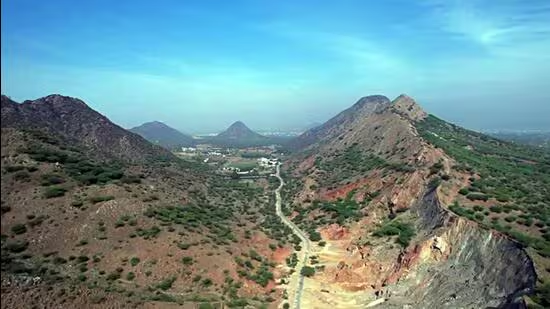
The Aravalli mountain range, older than the Himalayas and often called North India’s natural shield, has returned to the national spotlight following a recent Supreme Court verdict. The ruling, which excludes hills below 100 meters from the legally protected Aravalli zone, has triggered widespread debate and concern among environmentalists and policy experts.
Stretching from Delhi to Gujarat, the Aravallis are not just a chain of hills. Formed nearly two billion years ago during the Proterozoic era, they are among the oldest mountain ranges in the world. Unlike the towering Himalayas, their significance lies in their ecological role rather than their height.
Why the Aravallis Matter
First, the Aravalli range acts as a natural barrier against desertification. By blocking the eastward spread of the Thar Desert, it protects fertile lands in Rajasthan, Haryana, and beyond. Without this barrier, experts warn that arid conditions could rapidly expand.
Second, the hills serve as vital groundwater recharge zones. Rainwater seeps through the rocky terrain and replenishes aquifers, ensuring water security for millions across North India.
Moreover, the Aravallis play a key role in pollution control. They reduce dust storms and help improve air quality, especially in cities like Delhi, Gurugram, and Faridabad, which already struggle with severe pollution.
Geographical Spread Across States
The Aravalli range extends roughly 600–700 kilometers, passing through four regions:
Delhi, where the range begins
Haryana, covering Gurugram, Faridabad, and Nuh
Rajasthan, which hosts the largest stretch, including Alwar, Jaipur, Udaipur, and Mount Abu
Gujarat, where the range ends near Palanpur
Why Environmentalists Are Alarmed
Experts caution that excluding low-lying hills could open the door to illegal mining and unchecked real estate activity. Environmental groups fear that nearly 90 percent of the protected area could lose safeguards. As a result, air quality may worsen, groundwater levels may fall, and desertification could accelerate.
In short, the Aravalli range is not just an ancient geological formation. It is a living ecological system whose protection remains critical for the environmental future of North India.