
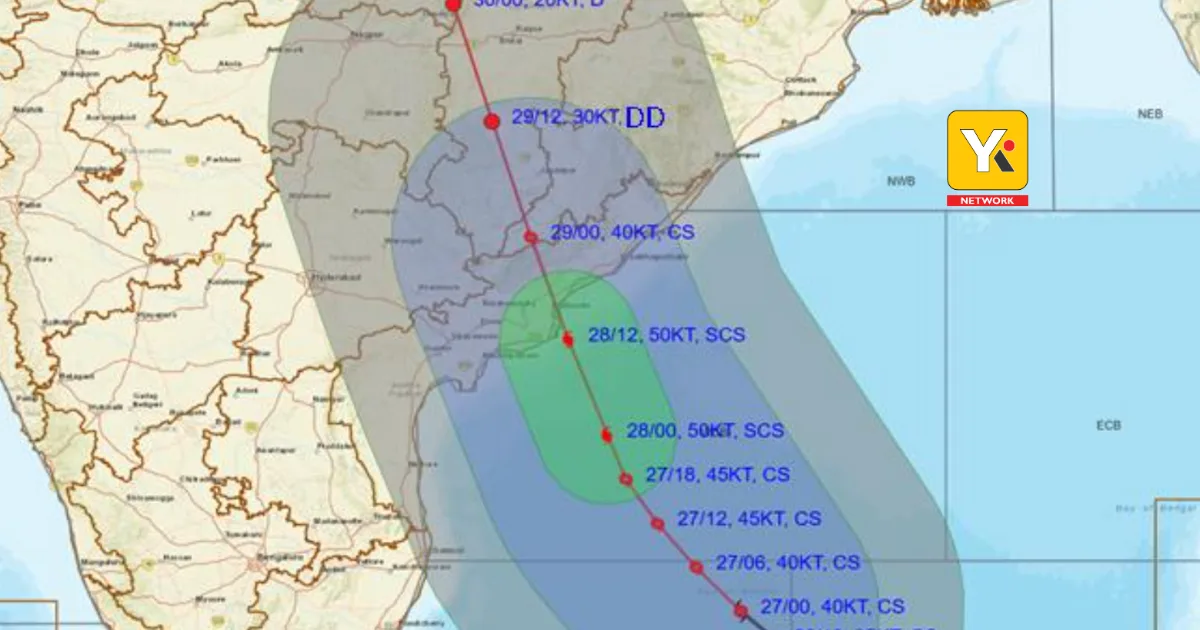
Why is Cyclone Montha different from other cyclones in the Bay of Bengal? In this YK TV exclusive, we will strive to comprehend how the latest cyclone has already put several State governments across the entire eastern coast on high alert for the first time in a long time.
First cyclone of the post-monsoon season
One of the unique aspects of Cyclone Montha is its formation. South East India, unlike other parts of the country, experiences two monsoon seasons. Southwest monsoon season and Northeast monsoon season. The formation of cyclones during these seasons is a common phenomenon given the geography of the tropical region. However, the formation of Cyclone Montha occurred during the withdrawal of the Southwest monsoon winds (post-monsoon season).
Dual ocean systems on the east and west coasts of India
Interestingly, Cyclone Montha developed simultaneously with a depression in the Arabian Sea, creating a rare dual-ocean system in the North India Ocean basin, impacting both of India’s coasts and monsoon withdrawal patterns at the same time. These dual cyclonic systems on the east and west coasts have made weather forecasting and preparedness operations usually complex.
Intensification of Montha ahead of schedule
The montha cyclonic system has intensified faster than expected. It transformed from a low-pressure area into a well-formed cyclonic storm within 48 hours. This is earlier than the usual post-monsoon timeline.
Irony in the naming of Cyclone Montha
Thailand gave the word Montha (pronounced as Mon-Tha) for the nomenclature of the latest cyclone. In Thai, montha means ‘a fragrant flower’, a calm and gentle meaning which is now in sharp contrast with the severe nature of the storm.
Widest impact zone in recent years
The Montha cyclone’s expected impact zone spans across Andhra Pradesh, Odisha, Tamil Nadu (especially Chennai), Telangana, Chhattisgarh and even parts of West Bengal (Coastal areas around Kolkata). This marks one of the widest alert distributions in IMD advisories.
Andhra Pradesh gears up for another ‘Hudhud’ level cyclone
It may be recalled that the Extremely Severe Cyclonic Storm Hudhud in October 2014 pounded the east coast, Andhra Pradesh and Odisha, especially the port city of Visakhapatnam. It caused extensive damage and forced the evacuation of nearly 3,50,000 people in Andhra Pradesh and Odisha.
For the first time since Cyclone Hudhud, the Andhra Pradesh government has initiated a full-scale disaster response plan. Both the Indian Army and the National Disaster Response Force (NDRF) teams have been deployed along with the State Disaster Response Force (SDRF) teams as early as the low pressure developed into a ‘deep depression’ stage.
The State government has also appointed 19 special officials to monitor the preparedness across the districts, which are expected to be adversely affected. Chief Minister Nara Chandrababu Naidu has also sanctioned 19 crore for evacuation and to set up relief shelters wherever necessary.
Cyclone Montha thus stands out not just for its strength or trajectory, but for how it represents a rare meteorological convergence and an unprecedented early-stage national preparedness effort across India’s eastern and western coasts.