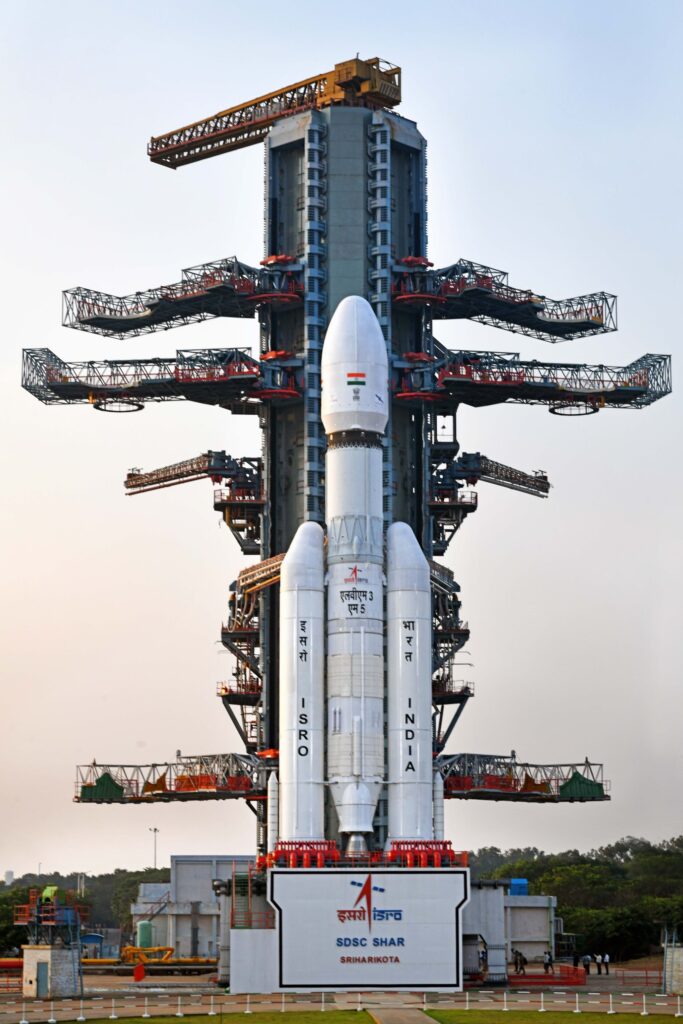

The Indian Space Research Organisation (ISRO) will mark a major milestone by launching India’s heaviest communication satellite, CMS-03, from the Satish Dhawan Space Centre (SDSC) in Sriharikota, Andhra Pradesh on Sunday.
The high-capacity spacecraft, GSAT-7R, will lift off at 5:26 PM IST on Sunday. The launch vehicle for this critical mission is the colossal Launch Vehicle Mark 3 (LVM3), ISRO’s most powerful and reliable rocket. ISRO has designated this flight as LVM3-M5, marking the rocket’s fifth operational mission.
A new benchmark for Indian space capability
The CMS-03 satellite is a multi-band military and civilian communication platform weighing approximately 4,400 kg, making it the heaviest communication satellite ever launched from Indian soil. Its deployment signifies a major leap in India’s indigenous space capabilities, as missions with such heavy payloads previously required foreign launch services.
ISRO confirmed that the 24-hour countdown for the launch began yesterday evening. Scientists at the control centre are currently conducting final checks to ensure a successful flight from the first launch pad at Sriharikota.
Enhancing connectivity and maritime security
The primary objective of the CMS-03 mission is to provide robust and higher-capacity bandwidth for communication services over the Indian landmass and a wide oceanic region.
Boost for the Navy: This satellite is critical for boosting connectivity for the Navy, providing transponders for secure voice, data, and video links across C, extended C, and Ku bands. This enhancement will significantly improve maritime domain awareness and strategic communication for the Indian Armed Forces.
Wider digital access: By offering greater bandwidth, the satellite will also aid civilian agencies, improving digital access to remote territories and supporting various strategic applications.
LVM3: India’s Baahubali heavy-lift launcher, the LVM3 rocket, a three-stage heavy-lift vehicle, is central to this mission. With a gross lift-off weight of over 640 tonnes, the LVM3 is capable of carrying up to 4,000 kg to Geosynchronous Transfer Orbit (GTO) and up to 8,000 kg to Low Earth Orbit (LEO).
Proven success: The LVM3 has a clean track record and was the vehicle responsible for launching the historic Chandrayaan-3 mission to the Moon, which made India the first country to successfully land near the lunar south pole.
The launch of the CMS-03 today will further cement the LVM3’s reputation as a versatile (baahubali) and dependable rocket, ensuring India’s self-reliance in the heavy-lift launch sector.