
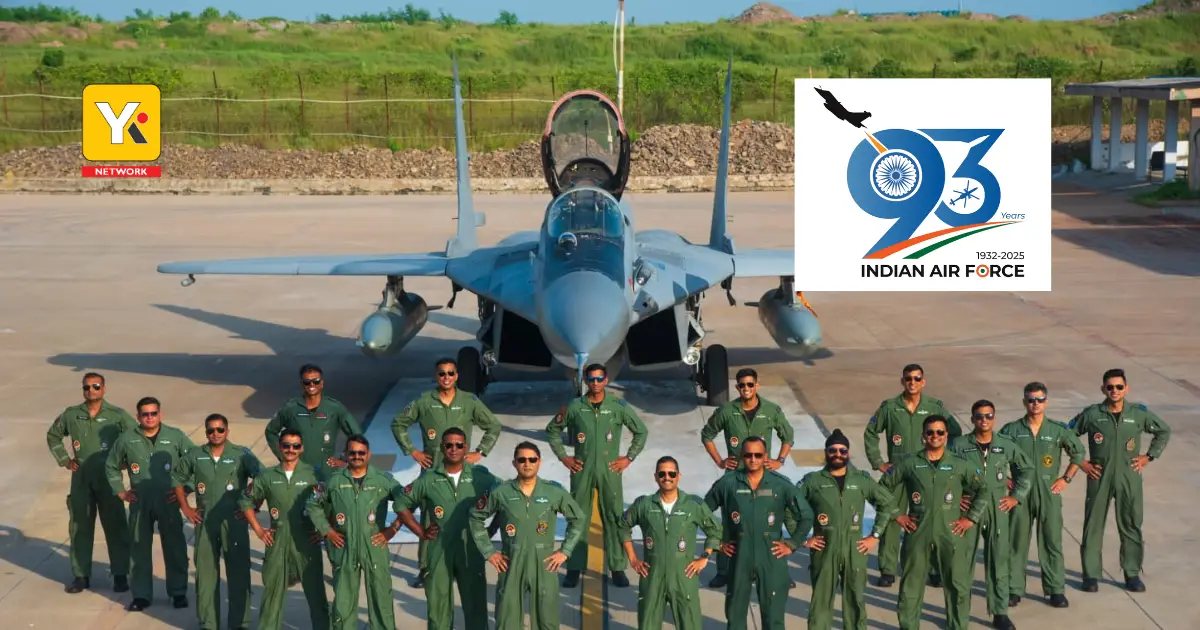
The Indian Air Force (IAF) has climbed to third place among the world’s top air forces and 6th place globally among all aviation forces, according to the 2025 Global Air Powers Ranking released by the World Directory of Modern Military Aircraft (WDMMA).
With a TrueValueRating (TvR) of 69.4 and 1,716 operational units, the IAF has once again surpassed China in qualitative ranking, despite China’s larger fleet of 3,733 aircraft. This marks another milestone in India’s rise as a major global air power.
India’s qualitative edge over China
While China’s fleet is numerically larger, India’s air force ranks higher due to quality, modernisation, and combat efficiency. India’s TvR score of 69.4 against China’s 63.8 reflects superior readiness, training, and technological advancement.
The Indian Air Force maintains a balanced inventory with around 32% fighter aircraft, alongside transport, refuelling and special mission platforms. Continuous modernisation programmes like HAL Tejas, AMCA, and upgrades to Su-30 MKI and Rafale fleets have strengthened operational effectiveness.
| Name of aviation force | TrueValueRating (TvR) | Total units/Aircrafts |
| United States Air Force | 242.9 | 5,004 |
| Russian Air Force | 114.2 | 3,677 |
| United States Army | 112.6 | 4,333 |
| United States Marines | 85.3 | 1,211 |
| Indian Air Force | 69.4 | 1,716 |
| Chinese Air Force | 63.8 | 3,733 |
Why India’s ranking matters?
India’s rise demonstrates the power of strategic modernisation and self-reliance. Through ‘Make in India’ and indigenous aerospace production, India is reducing dependence on imports while building domestic capability.
This focus on technology and innovation gives India a qualitative advantage in the region, especially against larger but less advanced forces. The key drivers behind India’s strong ranking
- Balanced fleet: Fighters, transport, and support aircraft enhance versatility.
- Operational experience: Decades of real-world missions and exercises build combat readiness.
- Indigenous industry: HAL, DRDO, and private sector collaborations ensure sustainable production.
- Modernisation push: Programmes like Deep Tech AI systems and drone integration improve efficiency.
- Strategic operations: Missions such as Operation Sindoor demonstrated advanced air warfare capability.
Also click here for the full report
India’s growing influence in the skies
The 2025 WDMMA report reinforces that air power is about quality, not quantity. India’s ability to combine technology, experience, and indigenous capability sets it apart from regional rivals.
With sustained investment and modern warfare training, the Indian Air Force continues to evolve into a global deterrent force, strengthening India’s position in both Asia’s security architecture and the global strategic order.