
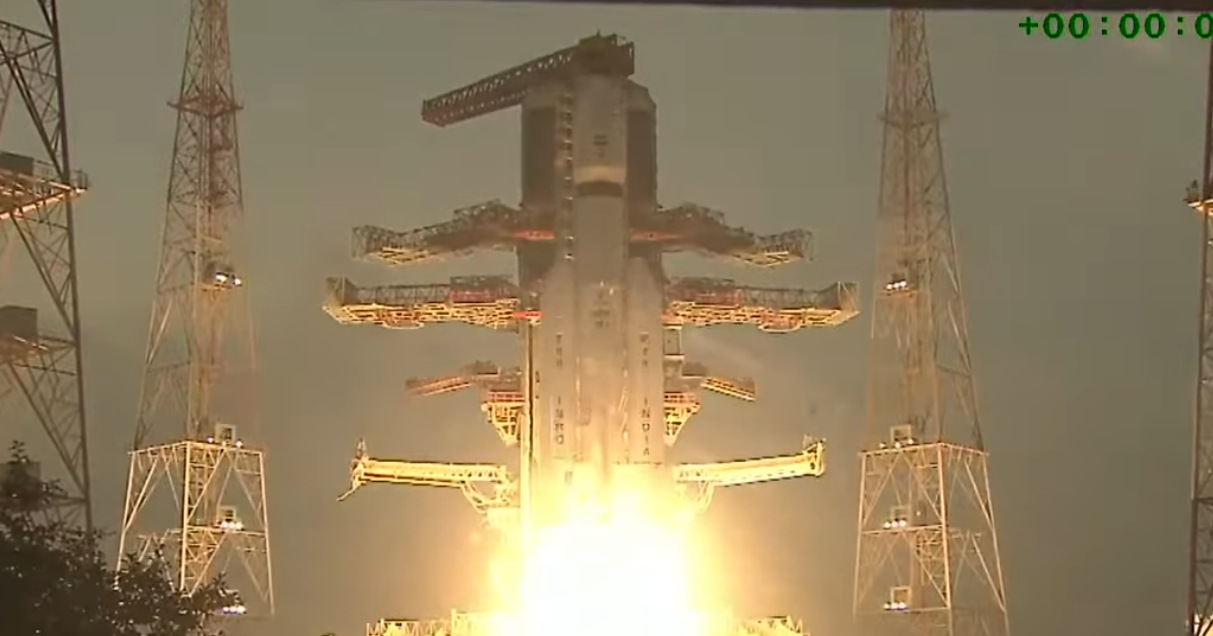
The Indian Space Research Organisation (ISRO) achieved a major milestone in indigenous space capability and maritime security on Sunday, November 2, successfully launching its heaviest-ever communication satellite from Indian soil.
At 5:26 PM IST, the powerful LVM-3 rocket, famously known as the ‘Bahubali of Indian rockets’, successfully launched the 4,410 kg CMS-03 satellite into a Geosynchronous Transfer Orbit (GTO) from the Satish Dhawan Space Centre in Sriharikota, Andhra Pradesh. The launch signals a new era for India’s self-reliance in the heavy satellite launch segment.
ISRO Chairman and Department of Space Secretary Dr V Narayanan announced the mission’s success. Subsequently, he also thanked the projects teams involved in this prestigious mission. He highlighted the growing launch capabilities of the ISRO. Furthermore, Dr V Narayanan also congratulated the scienctists and everyone involved.
Fortifying the Indian Navy’s strategic communications
The CMS-03 is a tailor-made, multi-band platform designed to serve as the new backbone for the Indian Navy’s communication network across the expansive Indian Ocean Region (IOR). Replacing its ageing predecessor, GSAT-7 ‘Rukmini’, the new satellite offers significantly upgraded features:
- Secure and high-capacity links: It provides secure, high-capacity voice, data, and video transmission capabilities.
- Network-centric operations: The CMS-03 is critical for enabling network-centric naval operations, ensuring real-time connectivity between naval assets, including warships, submarines, aircraft, and shore-based command centers, even in remote or contested maritime zones.
- Multi-band payload: The satellite carries multi-band payloads—C, extended C, Ku, UHF, and S bands—that deliver expanded coverage and bandwidth, enhanced by advanced encryption capabilities.
- Maritime domain awareness: It serves as a vital node in the Navy’s Maritime Domain Awareness (MDA) grid, boosting situational awareness and enabling coordinated responses to threats.
A stride for ‘Atmanirbhar Bharat’ in Space Technology
The successful deployment of CMS-03 is a pivotal moment for India’s strategic autonomy. By reducing the nation’s reliance on foreign launchers for heavy-class satellites and providing a dedicated, secure domestic platform, this mission reinforces the ‘Atmanirbhar Bharat’ (Self-Reliant India) initiative.
The satellite’s continuous geosynchronous position ensures uninterrupted, secure communications, covering the Indian subcontinent and wide areas of the adjoining ocean. Beyond defence, it supports civilian applications in disaster response, remote sensing, and telemedicine, advancing Indian space technology with sophisticated, dual-use indigenous systems.
The CMS-03 launch from Sriharikota not only cements ISRO’s formidable position in the heavy-launch market but also future-proofs India’s maritime security architecture against evolving geopolitical challenges.