
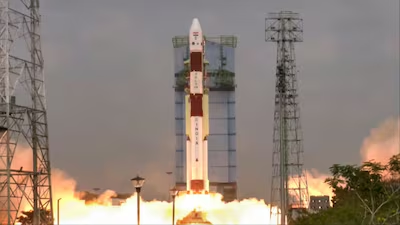
ISRO has started 2026 on a high note with a successful space mission. After closing last year with the powerful Bahubali rocket launch, the Indian Space Research Organisation achieved another milestone by launching PSLV-C62 at 10.18 am this morning.
At 10:18 am, ISRO launched the PSLV-C62 rocket from Launch Pad-1 at the Satish Dhawan Space Centre (SDSC), Sriharikota, in Andhra Pradesh. The mission carried the EOS-N1 Earth Observation satellite as its primary payload, along with 15 additional satellites.
First ISRO Mission of 2026 Takes Off Successfully
The PSLV-C62 is the 64th mission of the PSLV series and uses the PSLV-DL variant. Soon after liftoff, the four-stage rocket performed as planned. It placed the 1,485-kg EOS-N1 satellite into a sun-synchronous orbit at an altitude of about 506 km.
Within seconds of the main satellite deployment, ISRO released the remaining 15 satellites into their respective orbits. As a result, the mission achieved all its primary objectives smoothly.
EOS-N1 ‘Anveshan’ to Boost Defence and Environment Monitoring
ISRO scientists named the EOS-N1 satellite “Anveshan.” Developed for DRDO, the satellite will play a key role in defence surveillance, agriculture monitoring, and environmental studies. Moreover, it will help improve India’s strategic observation capabilities from space.
International Payloads and Spanish Re-Entry Test
In addition to Indian satellites, the mission carried payloads from Mauritius, Luxembourg, UAE, Singapore, Europe, and the United States. One of the highlights of the mission was KID (Kestrel Initial Technology Demonstrator), a 25-kg satellite from a Spanish startup, Orbital Paradigm.
After deployment, KID will test re-entry technology and perform a splashdown in the South Pacific Ocean. Meanwhile, ISRO also restarted the rocket’s fourth stage to support experimental objectives.
Another Major Success for ISRO
With the PSLV-C62 mission, ISRO once again proved its reliability in launching complex payloads with precision. Furthermore, the success strengthens India’s position as a trusted global launch partner.
As ISRO continues its ambitious space journey in 2026, missions like PSLV-C62 highlight the nation’s growing strength in space technology, defence applications, and international collaboration.
PSLV-C62 Launch Gains Importance After Past Setback
PSLV is known as the workhorse of ISRO due to its long record of success. Out of 63 launches, the rocket has powered historic missions such as Chandrayaan-1, the Mangal Orbiter Mission, and Aditya-L1. In 2017, PSLV created a world record by launching 104 satellites in a single mission. However, the PSLV-C61 mission failed in May last year, which made the PSLV-C62 launch highly significant for ISRO. Scientists said the total mission duration was planned for about 1 hour and 48 minutes, marking ISRO’s first launch of 2026.
EOS-N1 Satellite Aims to Boost Defence, Agriculture and Disaster Response
Meanwhile, the EOS-N1 (Anvesha) satellite launched aboard PSLV-C62 aims to bring major advancements in defence, agriculture, and disaster management. Using advanced hyperspectral technology, it can detect crop health, soil moisture, forest activity, and hidden enemy movements. It will also help farmers identify pests and drought conditions while supporting disaster response during cyclones and forest fires. However, ISRO Chairman V. Narayanan confirmed that the mission faced a disruption after the third stage. Although the rocket lifted off successfully at 10:18 am from Sriharikota, engineers are now analysing the issue to identify the exact cause.
For more latest updates, click here.