
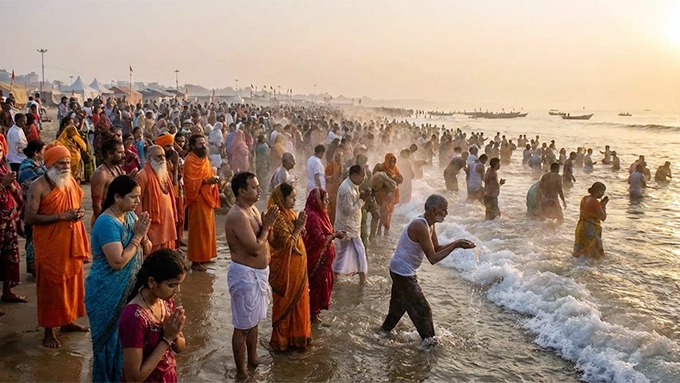
Mauni Amavasya falls on Pushya Bahula Amavasya, the first new moon after the start of Uttarayana. Devotees across India observe this day with spiritual discipline, silence, and holy baths, believing it brings inner purification and relief from planetary afflictions.
Why the Name ‘Mauni Amavasya’?
The word Mauni comes from Mauna, meaning silence. On this day, sages, saints, and spiritual seekers observe Mauna Vrata and focus deeply on meditation and penance. In North India especially, devotees treat silence as a form of worship. Those who attain spiritual discipline through penance earn the title Mauni. Hence, the day came to be known as Mauni Amavasya.
A holy dip on this day holds special importance. Bathing at the Triveni Sangam, the Godavari, or the sea is considered highly auspicious.
Sapta Sagara Yatra and Chollangi Amavasya
According to tradition, Sage Gautama’s penance gave rise to the Godavari. Seven sages later carried its waters to seven sea confluences. These sacred spots form the Sapta Sagara Yatra. Devotees believe that bathing at all seven confluences grants the merit of bathing in all seven oceans.
The final ritual concludes at Chollangi, where the Godavari meets the sea on Pushya Bahula Amavasya. Because of this, people also call the day Chollangi Amavasya. Devotees believe this ritual removes known and unknown sins.
Special Solar Significance This Year
This year, Mauni Amavasya falls on Sunday, making it more powerful. On Amavasya, the Sun remains strong, and when the day coincides with Sunday, it enhances solar energy.
Astrologers advise people with planetary doshas to take a holy bath early in the morning. Offering Arghya to the Sun with red flowers and red sandalwood can help reduce Kuja, Rahu, and Ketu doshas. Devotees believe this ritual improves health and mental strength. Bathing during Brahma Muhurta or within 90 minutes of sunrise brings maximum spiritual benefit.
Pitru Rituals and Charity
Mauni Amavasya also marks Pitru Parva. Those facing Pitru Dosha can perform Anna Dana, curd donation, salt donation, or pumpkin donation. Scriptures state that donating an ash gourd to a deserving Brahmin equals donating gold of the same weight.
Those who missed Sankranti rituals can perform them on this day for similar benefits.
Worship of Fierce Deities
Devotees also worship Kala Bhairava, Veerabhadra, and Mahakali on Mauni Amavasya. People troubled by debts or financial stress offer garlands of black gram vadas and light ash gourd lamps at Kala Bhairava temples.
For mental stress, speech disorders in children, or fear-related issues, devotees worship Veerabhadra and Bhadrakali with bilva leaves and lemon garlands. Many believe these rituals remove negative energies and planetary troubles.
In several regions, families also worship thorny Gara branches during Pradosha time on Sunday Amavasya to ward off planetary doshas.
Conclusion
Mauni Amavasya blends silence, devotion, charity, and solar worship. Devotees believe sincere observance on this sacred day brings spiritual strength, health, and relief from long-standing troubles.
For more latest updates, click here.