
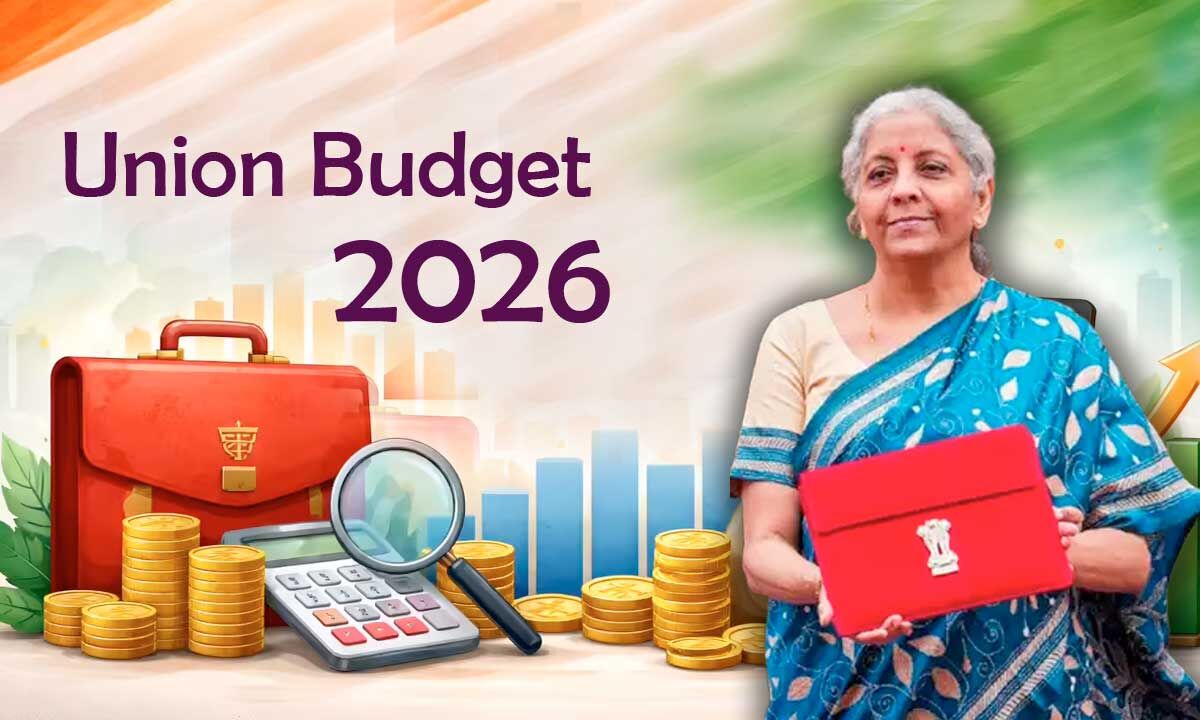
Union Finance Minister Nirmala Sitharaman presented the Union Budget 2026 with a strong message of economic confidence, inclusive growth, and future-ready reforms. Addressing global trade tensions, the Finance Minister assured that India’s economy remains resilient and will not collapse due to international trade wars. While the United States continues to be India’s largest export partner and has imposed high import duties, the government made it clear that India no longer depends only on exports for growth.
Instead, the budget focuses on strengthening domestic demand, infrastructure, innovation, and self-reliance. The announcements bring good news for states like Andhra Pradesh and open new opportunities for farmers, youth, creators, NRIs, and taxpayers.
India’s Economy Remains Strong Amid Global Trade Tensions
Speaking on global trade challenges, Nirmala Sitharaman underlined that India has diversified its economic drivers. Although higher tariffs from major markets like the US may impact exports, the government has reduced its overdependence on foreign trade. As a result, global trade conflicts will not derail India’s growth story.
The Finance Minister highlighted strong economic discipline, pointing out that GST collections touched ₹1.93 lakh crore in January. Controlled inflation and stable revenues reflect the strength of the Indian economy. India is steadily moving toward self-reliance while maintaining global competitiveness.
Andhra Pradesh Gets a Major Boost in Union Budget 2026
The budget brought encouraging news for Andhra Pradesh, Kerala, and Odisha. The Centre announced a special scheme for the extraction of critical minerals in these states. This move aims to reduce import dependence and strengthen India’s industrial supply chains.
In addition, the government will set up three new chemical parks across the country. These parks will support industrial expansion and attract fresh investments. The textile sector will also undergo modernisation, with the goal of generating large-scale employment, especially for rural and semi-urban workers.
Budget Built on Three Core Responsibilities
The Finance Minister explained that the Union Budget 2026 rests on three key pillars that guide India’s development path.
The first pillar focuses on inclusive economic growth, ensuring that development benefits reach every section of society. The second pillar emphasises public participation, bringing everyone—from farmers to entrepreneurs—into the growth process. The third pillar follows the vision of “Sabka Saath, Sabka Vikas,” combining reforms with comprehensive development.
Together, these pillars aim to create balanced growth across regions and communities.
Seven High-Speed Rail Corridors to Transform Connectivity
One of the biggest infrastructure announcements in Budget 2026 is the development of seven high-speed rail corridors connecting major metro cities. These corridors will significantly cut travel time and boost trade, tourism, and employment.
The proposed corridors include Mumbai–Pune, Pune–Hyderabad, Hyderabad–Bengaluru, Hyderabad–Chennai, Chennai–Bengaluru, Delhi–Varanasi, and Varanasi–Siliguri. Notably, Hyderabad will emerge as a key hub in South India with three major corridors.
To support such mega projects, the government allocated a record ₹12.2 lakh crore for capital expenditure. These rail projects will follow eco-friendly designs with low carbon emissions.
NRIs Get Easier Investment Access
The Union Budget 2026 places special focus on Non-Resident Indians. The government plans to simplify investment rules for NRIs who want to participate in India’s growth. Portfolio investment limits in Indian stock markets will increase, and barriers to direct equity investments will reduce.
By easing capital market access, the Centre aims to attract more foreign funds and strengthen India’s financial ecosystem.
Healthcare and Education Expansion Across India
To improve access to quality healthcare, the government will establish five new regional medical centres. Alongside this, new institutions will support medical education and pharmaceutical research.
These steps aim to strengthen healthcare delivery while creating skilled jobs in the medical and research sectors.
Agriculture Reforms to Increase Farmer Income
The budget introduces innovative plans to make agriculture more profitable. Instead of limiting farmers to traditional crops, the government encourages high-value cultivation to boost incomes.
For coastal farmers, the Centre announced a coconut development scheme. Farmers will receive incentives to replace old coconut trees with high-yield varieties. The budget also supports the expansion of cashew and cocoa cultivation in coastal regions.
To support fishermen, the government will develop fisheries in 500 major reservoirs. Cold storage and processing units near water bodies will create jobs and reduce post-harvest losses.
In states like Andhra Pradesh, subsidies will promote sandalwood plantations. The government also announced special schemes for almond, walnut, and pine nut cultivation in suitable regions. Youth entering dairy and poultry businesses will receive low-interest loans and subsidies.
Big Relief for Income Taxpayers
Union Budget 2026 brings significant relief for income taxpayers. The government simplified the tax system by removing complex rules and introducing shorter, easier-to-file forms from April 1.
Taxpayers will now have time until March 31 to correct errors in their Income Tax Returns, instead of the earlier December 31 deadline. Interest earned on compensation awarded in road accident cases will no longer attract tax, offering relief to affected families.
The government will also introduce a single “Tax Year” system, removing confusion between the assessment year and the financial year. Taxpayers can claim pending TDS refunds even after the ITR deadline without paying penalties.
Content Creators and AVGC Sector Get a Major Push
The Union Budget 2026 delivers exciting news for content creators and the digital economy. The government announced strong support for animation, visual effects, gaming, and comics under the AVGC sector.
To build digital skills early, the Centre will set up advanced creator labs in 15,000 secondary schools and 500 colleges. These labs will offer hands-on training in video editing, graphic design, and digital storytelling, with support from the Indian Institute of Creative Technologies in Mumbai.
The government aims to turn India into a global gaming hub and create one million gaming jobs in the near future. By 2030, the AVGC sector may require nearly two million skilled professionals. To meet this demand, ITIs and polytechnic colleges will introduce gaming development courses.
An AVGC mission will support original IP creation, while improved digital infrastructure will ensure high-speed internet access even in rural areas.
A Budget Focused on Future India
Overall, the Union Budget 2026 moves beyond traditional employment and focuses on building a modern, creative, and innovation-driven economy. By investing in infrastructure, agriculture, healthcare, youth skills, and digital industries, the government aims to convert smartphones and internet access into real income opportunities.
The budget reflects a clear vision to empower citizens, strengthen states like Andhra Pradesh, and position India as a resilient and self-reliant global economy.
For the latest updates, click here.