
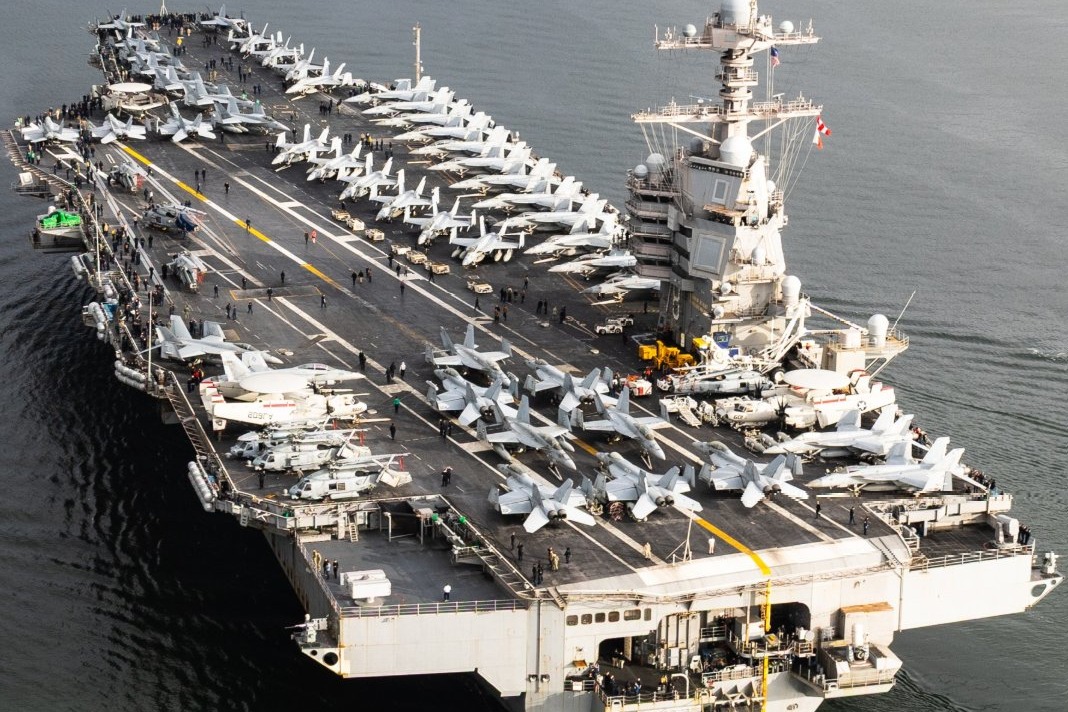
In a significant military move, the Trump administration has ordered the deployment of the USS Gerald R. Ford, the world’s largest aircraft carrier, from the Caribbean Sea to the Middle East and Persian Gulf. This powerful warship will join the USS Abraham Lincoln strike group already stationed in the region.
With two carrier strike groups operating in the same theatre, the United States is significantly strengthening its naval presence. As a result, global attention has shifted toward Washington’s strategic intentions in West Asia.
A Massive Show of Naval Strength
The USS Gerald R. Ford does not operate alone. It sails with an advanced strike group that includes guided missile destroyers such as the USS Frank E. Petersen Jr., the USS Spruance, and the USS Michael Murphy. Together, these warships form one of the most advanced naval formations in the world.
By combining the Ford and Lincoln strike groups, the U.S. gains unmatched airpower, missile defence capability, and rapid strike readiness in the region. Moreover, reports suggest that Ford’s deployment could extend up to 10 months, potentially keeping it in the area until early May next year.
Such long-term positioning signals that this is not a routine patrol. Instead, it reflects a calculated strategic decision.
Pressure Mounts Over Iran’s Nuclear Program
The deployment comes at a sensitive moment in U.S.-Iran relations. President Donald Trump has warned that military action remains an option if diplomatic efforts fail. Currently, the United States and Iran are engaged in indirect nuclear negotiations taking place in Oman.
Although talks continue, progress has been slow. Therefore, many international analysts interpret the carrier deployment as a message of deterrence. By increasing its military presence, Washington aims to apply maximum pressure while leaving the door open for diplomacy.
At the same time, U.S. officials stress that the buildup is defensive in nature. They argue that it ensures regional stability and protects American interests and allies.
Rising Anxiety Across West Asia
However, the arrival of a second carrier strike group has sparked fresh concerns across West Asia. Military experts warn that such a concentration of naval power near Iranian waters increases the risk of miscalculation.
Even a small incident at sea or in contested airspace could escalate quickly. Consequently, regional observers fear that tensions may spiral if diplomatic channels break down.
Several Gulf nations are closely monitoring the situation. While some welcome stronger U.S. security support, others worry about being drawn into a larger confrontation.
The Strategic Importance of USS Gerald R. Ford
The USS Gerald R. Ford represents the latest generation of American aircraft carriers. It features advanced radar systems, enhanced aircraft launch technology, and improved operational efficiency. Because of its size and firepower, it serves as a floating airbase capable of launching sustained combat operations.
In previous deployments, the carrier has played roles in high-stakes missions, including operations linked to Venezuela and other sensitive geopolitical situations. Its presence often signals serious U.S. strategic intent.
Now, as it moves toward the Persian Gulf, the ship once again becomes a symbol of American military reach and readiness.
What Happens Next?
At this stage, the deployment does not automatically signal imminent conflict. Instead, it highlights the delicate balance between diplomacy and deterrence.
On the one hand, negotiations in Oman continue. On the other hand, Washington is clearly preparing for all possible outcomes. If talks succeed, the carriers may serve as leverage that helps secure an agreement. However, if diplomacy collapses, the region could face a period of heightened instability.
For now, the world watches closely. The coming weeks will determine whether this show of force strengthens peace through deterrence or deepens an already fragile standoff.
For the latest updates, click here.