
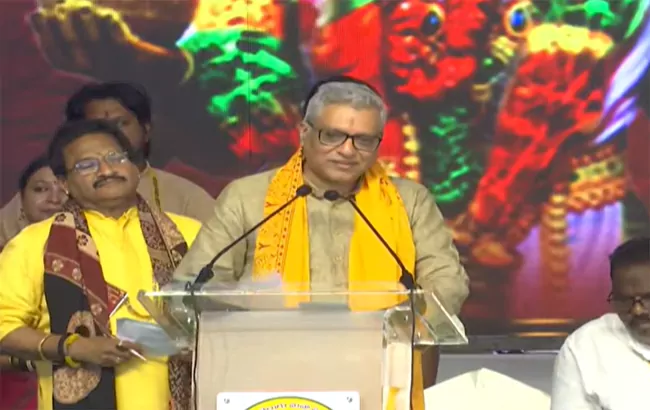
The Third World Telugu Conference continues in Guntur with vibrant participation and cultural pride. Scholars, judges, writers, artists, and public representatives from different regions are attending the event. As a result, the conference has emerged as a major platform to discuss the future of Telugu in education, governance, and public life.
Language as a Cultural and Emotional Bond
At the inaugural session, Supreme Court Judge Justice Pamidighantham Srinarasimha delivered a thought-provoking address. He said he never imagined such a grand global conference dedicated to Telugu. According to him, every individual is born with two powerful bonds. One connects a person to the mother, while the other connects them to language.
Importantly, Justice Srinarasimha explained that language goes beyond emotional expression. Instead, it shapes ideas, builds cultures, and creates entire worlds. Through language, people across regions remain connected. Therefore, Telugu gives its speakers a strong identity and a sense of belonging that cannot be replaced.
Push for Telugu in Governance and Judiciary
Turning to governance, Justice Srinarasimha urged authorities to increase the use of Telugu in official work. In his view, public administration becomes more inclusive when it uses the people’s language. Moreover, he strongly supported conducting court proceedings in Telugu up to the district level.
When courts use the mother tongue, people understand justice more clearly. Consequently, trust in the judicial system grows. He expressed hope that governments and institutions would act on this long-pending demand. His remarks received wide appreciation from the audience.
Mother Tongue Education Builds Strong Foundations
Meanwhile, former JD Lakshminarayana highlighted the importance of education in the mother tongue. Referring to the National Education Policy, he said students should study in their native language at least until the fifth standard. According to him, this approach strengthens learning at an early stage.
Sharing his own experience, Lakshminarayana said that his command over Telugu helped him learn five languages with ease. In fact, many globally successful personalities began their education in their mother tongue. Therefore, he argued, language should never be seen as a barrier to success.
Jobs Depend on Knowledge, Not Just English
Furthermore, Lakshminarayana stressed that employment opportunities do not come from English alone. Instead, strong subject knowledge and practical skills create real opportunities. For this reason, he urged governments and public representatives to focus more on strengthening regional languages in education.
Alongside these speeches, cultural performances, literary discussions, and intellectual debates are continuing at the conference. Together, they reflect the depth and richness of Telugu heritage.
Overall, the World Telugu Conference has renewed the call to give Telugu its rightful place in governance, courts, and classrooms. Organisers believe that the discussions held in Guntur will inspire the younger generation to take pride in their language and preserve it for the future.